

From Idea to First Production · Guide 5 / 6
Understanding Apparel Costing, MOQs and Production Timelines
Understand apparel costing, minimum order quantities and realistic production timelines before requesting a garment manufacturing quotation.
10 min read
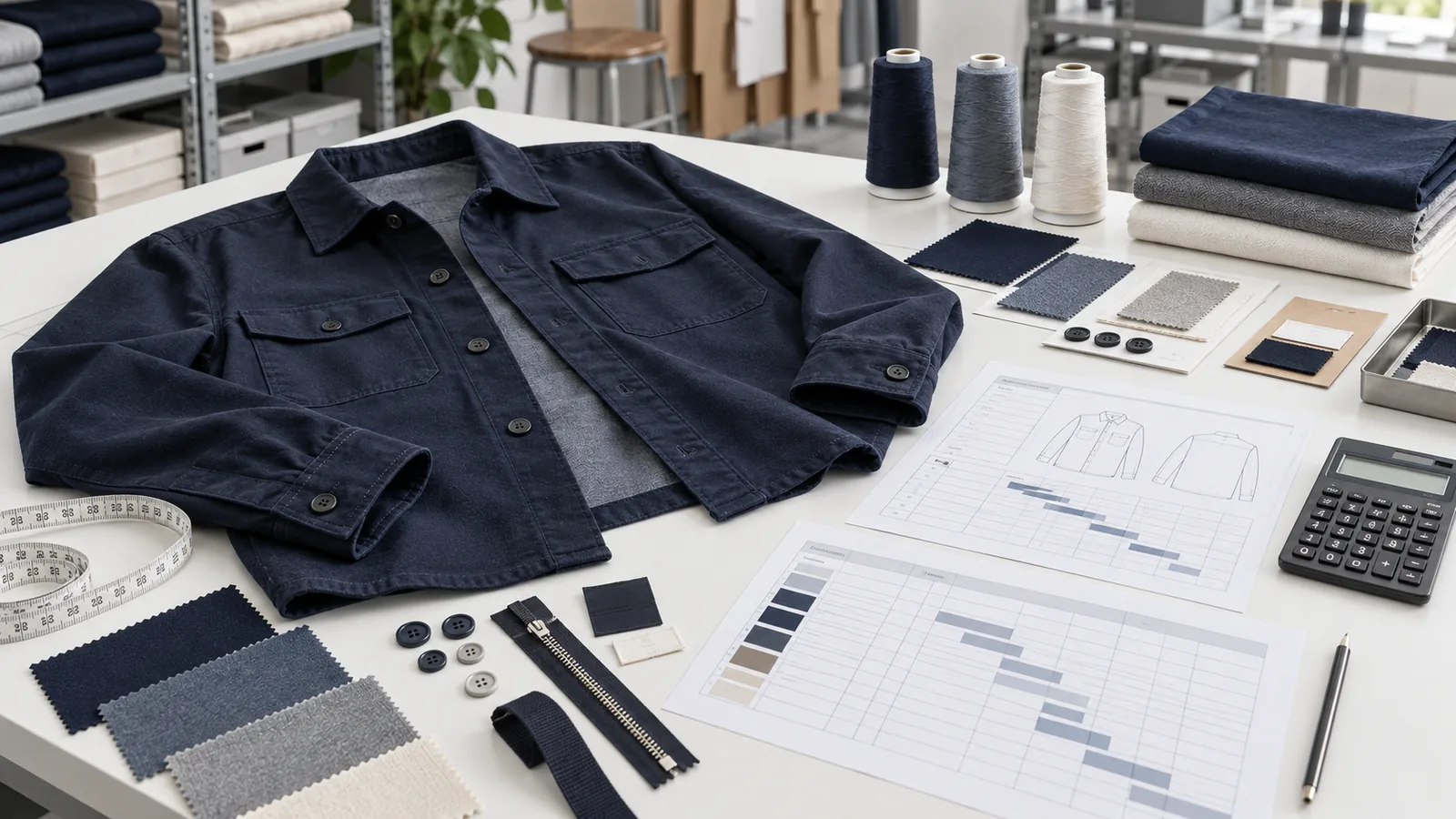
After a product has been defined and sampled, three questions usually become urgent: What will it cost? What is the minimum order? When can it be delivered?
These questions are connected. A price cannot be evaluated without knowing the product specification and quantity structure. A minimum cannot be understood without checking fabric, color, trim and production requirements. A delivery date cannot be confirmed until materials, approvals and production capacity are aligned.
For an emerging brand, the aim is not to accept every number a supplier provides. It is to understand what the number represents, which assumptions remain open and what decisions could change the result.
A Cost Is the Result of Product Decisions
A garment quotation is not simply a factory charge attached to a sketch. It reflects a defined product, materials, construction, processing, quantity, quality requirements, packaging and commercial terms.
Two garments that look similar in a photograph can have different costs because their fabric weight, consumption, seam construction, wash, print, labels, testing or packing requirements differ. A price comparison is useful only when suppliers are quoting the same specification and commercial scope.
Early estimates are sometimes necessary, but they should be identified as estimates. The quotation becomes more reliable as the tech pack, bill of materials, approved sample and quantity breakdown become clearer.
What May Be Included in Garment Costing
The exact format varies, but the main cost groups normally include the following.
Main fabric and consumption
Fabric cost depends on more than a price per metre or kilogram. Composition, yarn, construction, weight, width, finish, dyeing method and supplier conditions all matter. The amount consumed by one garment also depends on pattern shape, size range, fabric width, shrinkage allowance, matching requirements and marker efficiency.
A small change in garment length or fabric width can affect consumption across an entire order. This is why a final cost may change after the pattern and marker are reviewed.
Trims and components
Thread, zippers, buttons, snaps, elastics, drawcords, interlining, shoulder pads and other components belong in the bill of materials. Custom colors, finishes, moulds or branded hardware may bring their own minimums and setup charges.
Labels, care labels, hangtags, stickers, polybags, tissue and cartons must also be defined. They may look minor individually, but an incomplete packaging brief can leave a meaningful part of the order outside the initial quotation.
Cutting and making
Construction cost reflects the work needed to cut, prepare, sew, press and finish the garment. The number and type of operations, handling difficulty, machine requirements, quality level and expected line efficiency influence this part of the price.
A basic jersey T-shirt and a lined woven jacket do not use production resources in the same way. Extra panels, pockets, bindings, topstitching or difficult materials add operations even when the visual difference seems small.
Printing, embroidery, washing and finishing
Screen printing, digital printing, embroidery, garment dyeing, washing, distressing, pleating and other treatments should be quoted against a defined artwork, placement, size, color count and finish standard. Sampling and setup may be separate from the recurring unit cost.
Processes such as denim washing can also affect measurements, shade and testing requirements. The approved finish must therefore be considered together with the garment specification rather than added at the end as decoration.
Testing, inspection and compliance
Laboratory tests, third-party inspections, special documentation and buyer-specific compliance requirements may sit inside or outside the garment price. The quotation should state what is included instead of assuming that every supplier uses the same scope.
Freight, duties and commercial terms
An ex-factory garment cost is not the same as the final landed cost in the buyer's market. Transport, insurance, customs procedures, duties and local handling depend on the agreed delivery terms and destination. Compare like with like and ask which costs and responsibilities transfer at each stage.
Why an Incomplete Brief Produces a Provisional Price
A request that says only “200 hoodies in premium cotton” leaves important decisions unanswered. The price may change when the fabric weight, composition, color count, size ratio, construction, print, labels, packaging, testing and delivery terms become known.
For a useful quotation, provide at least:
- Technical drawings or clear reference images
- Measurement specification or available sample
- Fabric composition, weight and finish direction
- Trim, branding and packaging requirements
- Colorways and artwork
- Total quantity and breakdown by style, color and size
- Required tests or market-specific requirements
- Delivery destination and requested commercial term
- Target date and current approval status
If some points are not decided, mark them as open. A transparent assumption is easier to revise than a hidden one.
MOQ Is Not Always One Number
Minimum order quantity, or MOQ, is often discussed as if a manufacturer has one fixed figure for every project. In practice, several minimums may overlap.
Production minimum
The production setup must support cutting, line planning, machine preparation and quality control efficiently enough for the style. A complex product may require a different viable quantity from a simple repeat style.
Fabric minimum
A mill may set a minimum for a fabric construction, dye lot or custom development. If the garment order uses less fabric than that minimum, the brand may need to use an available stock quality, accept a fabric surcharge, purchase excess material or reconsider the order structure.
Color minimum
Custom dyeing and finishing often have minimums per color. Dividing a modest total quantity across many colors can therefore be more difficult than placing the same total in one or two colors.
Trim and branding minimum
Zippers, elastic, buttons, woven labels, packaging and branded components can each carry supplier minimums. The garment maker may be willing to sew a quantity that a component supplier cannot economically produce as a custom order.
Style and size breakdown
The total order is only part of the calculation. Ten styles, five colors and a wide size range create more setups and smaller cutting groups than one focused style in two colors, even when the total unit count is identical.
Ask whether the stated MOQ applies per order, style, fabric, color or component. Without that distinction, the number is incomplete.
Why Lower Quantities Often Cost More Per Unit
Some costs are incurred once, regardless of whether an order contains 100 or 1,000 pieces. Pattern preparation, marker planning, color setup, machine adjustment, cutting setup, quality documentation and packing preparation are examples. When these costs are spread across fewer units, the cost per garment rises.
Material suppliers may also charge more below their standard volume, while production lines lose efficiency when they change style frequently. This does not make a smaller opening order unreasonable. It means the order should be structured deliberately rather than compared directly with high-volume pricing.
Build a Focused Opening Quantity
For a new brand, a controlled first order may be more valuable than a broad collection that fragments the budget. Consider:
- Launching fewer styles with a clearer product purpose
- Limiting initial colorways
- Using compatible materials across related styles
- Choosing stock or readily available fabrics where suitable
- Reserving custom hardware for a later repeat order
- Concentrating the size range on a reasoned sales plan
- Confirming whether excess fabric or trims can be held for repeats
Do not remove product details that are essential to quality or compliance only to reach a lower number. The goal is to reduce unnecessary variation, not to make the specification ambiguous.
A Production Timeline Has Several Clocks
“Four weeks” can mean four weeks of sewing, four weeks after materials arrive or four weeks from purchase order to ex-factory completion. Those are different commitments.
A realistic schedule may include:
- Final brief and quotation review
- Sample corrections and production approval
- Purchase order and commercial confirmation
- Fabric and trim ordering or production
- Lab dips, strike-offs, artwork or wash approvals
- Pre-production planning and capacity booking
- Cutting, sewing and inline control
- Finishing, measurement checks and final inspection
- Packing and export preparation
- Transport to the agreed destination
Some stages can overlap; others cannot. Bulk cutting should not begin while a decision that affects the pattern, material or finish remains unresolved.
When Does the Lead Time Actually Start?
The start point should be written into the order. Depending on the arrangement, the schedule may begin only after several conditions are met:
- Purchase order and payment terms are confirmed
- Final tech pack and quantity breakdown are issued
- Production sample or agreed approval stage is signed off
- Fabric, trims, colors and artwork are approved
- Required buyer documents are received
- Production capacity is booked
A requested delivery date is not automatically a confirmed delivery date. Confirmation requires the production partner to review material lead times, approval status and available capacity together.
Decisions Can Extend or Protect the Schedule
Late changes do not add only the time required to write an email. A new color may require another lab dip; a changed zipper may require a new supplier order; a fit correction may alter the pattern, marker and consumption; revised artwork may restart print approval.
To protect the calendar:
- Keep one current tech pack and bill of materials
- Assign a decision maker on the buyer side
- Consolidate comments instead of sending conflicting messages
- Approve physical color and material references by agreed dates
- Freeze production-critical details before bulk starts
- Record what a date depends on
- Communicate launch deadlines early, including freight time
- Allow contingency for complex, custom or first-time processes
Speed comes more reliably from prepared decisions than from an unrealistically short number placed on a quotation.
Compare Quotations on the Same Basis
The lowest unit figure is not necessarily the lowest workable cost. Before comparing quotations, check:
- Whether the same fabric quality and consumption are used
- Whether trims, labels and packaging are included
- Whether prints, embroidery, washing or special finishes are included
- Which sample, setup and testing costs are separate
- Which quantity and color breakdown the price assumes
- Which delivery term and currency apply
- How long the price remains valid
- Which approvals are required before production
- Whether freight, duties or inspection are excluded
A concise comparison sheet is more useful than comparing totals copied from unrelated emails.
Common Costing and MOQ Misunderstandings
Avoid these assumptions:
- A photo is sufficient for a final production price
- One MOQ applies to every material, color and style
- Doubling the quantity will always halve the unit price
- A lower unit price automatically gives a lower landed cost
- Sample cost should equal bulk unit cost
- Every quotation includes testing, labels, packaging and freight
- An estimated lead time is a reserved production slot
- Production begins immediately after the first payment
- Buyer changes do not affect price or delivery
- A repeat order will have the same price without checking material and market changes
Before Confirming a Production Order
Confirm the commercial and technical basis in writing:
- Style codes and current document versions
- Approved samples, materials, colors and artwork
- Quantity by style, color and size
- Unit price, currency and price validity
- Included and excluded cost items
- Sample, development, testing and inspection charges
- MOQ and any material surplus arrangement
- Payment and delivery terms
- Lead-time start point and planned completion date
- Approval deadlines and responsible people
- Packing, shipping marks and export documents
- Procedure for approved changes or exceptions
The purpose is not to make the process unnecessarily formal. It is to ensure that both parties are planning the same product, scope and calendar.
Request a Cost and Timeline Review
All In Denim can review your tech pack, reference sample, material direction, quantity breakdown, target market and requested delivery window before discussing an appropriate production setup in Türkiye.
Cost, minimum quantities and timing depend on the actual product, materials, processes, order structure, approval status and available capacity. A clear review provides a stronger basis for a quotation than a general request for the lowest price and fastest delivery.
Request a Production Review
References
Related services
Related Manufacturing Services
Explore the All In Denim services most closely connected to this guide.
Manufacturing Capabilities
Review sourcing, sampling, production follow-up, quality control and export preparation support.
Production Process
Follow the stages from technical review and sampling through bulk production and export coordination.
Product Categories
Explore denim, woven garments, knitwear, underwear, loungewear and private label categories.
Ready to discuss your product?
Send your product brief, tech pack, reference images, estimated quantities, target market, and timeline for an initial production review.