

From Idea to First Production · Guide 2 / 6
Building a Tech Pack Manufacturers Can Work With
Learn how to prepare a clear apparel tech pack for costing, sampling and production, including technical flats, measurements, materials, construction, labels and revision control.
8 min read
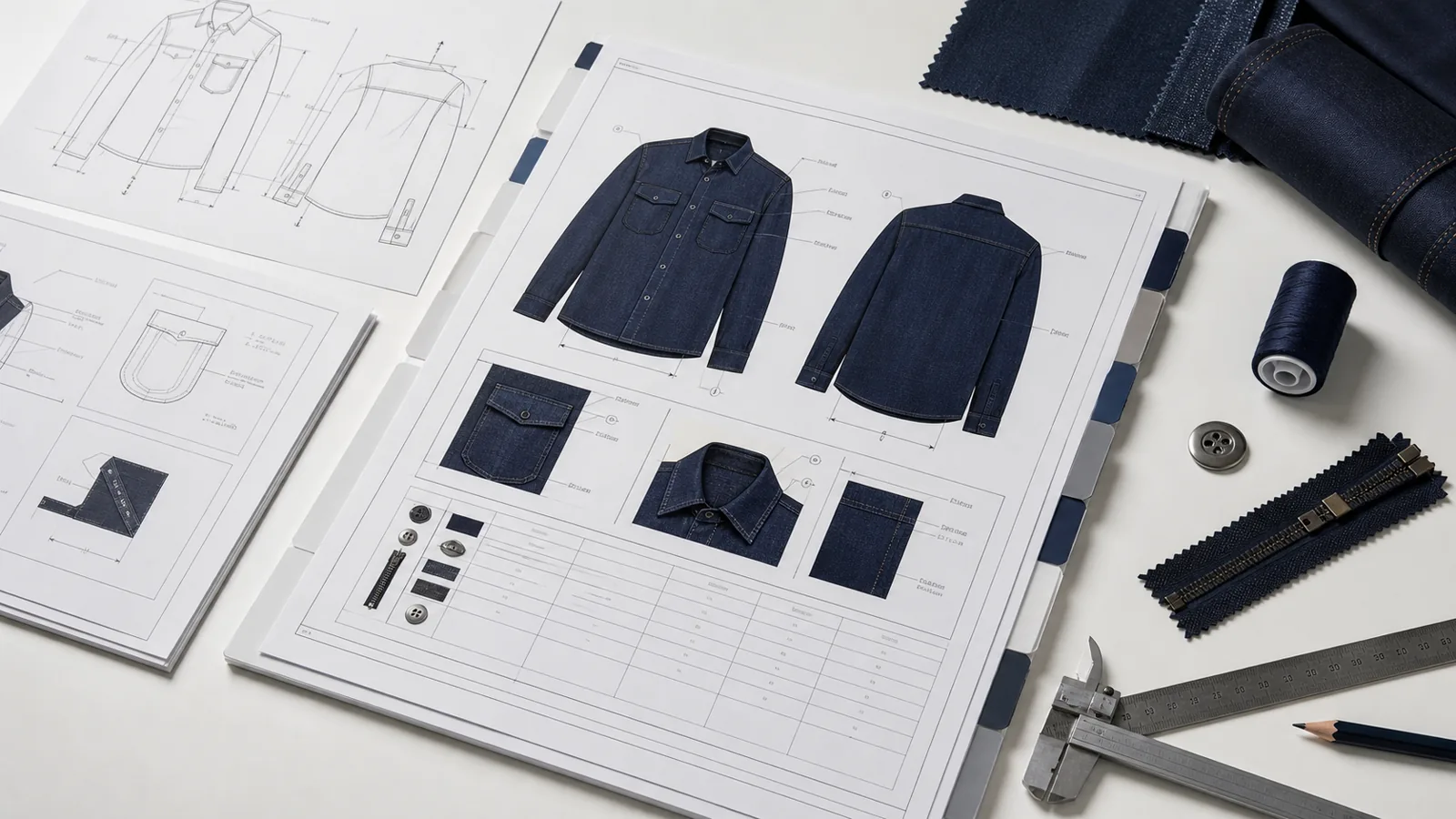
A tech pack is not simply a polished presentation of your design. It is a working technical document that allows a manufacturer to understand, price, sample and eventually produce a garment with fewer assumptions.
For an emerging brand, a good tech pack also communicates something important: the project has been considered seriously.
It does not need to prove that you are placing a large order. It should demonstrate that you understand your product, can make decisions and are prepared to manage development in an organized way.
Technical-design education treats the tech pack as part of the complete product-development process. It connects technical illustrations, construction, measurements, materials, trims, color, fit and production requirements rather than presenting them as separate documents.
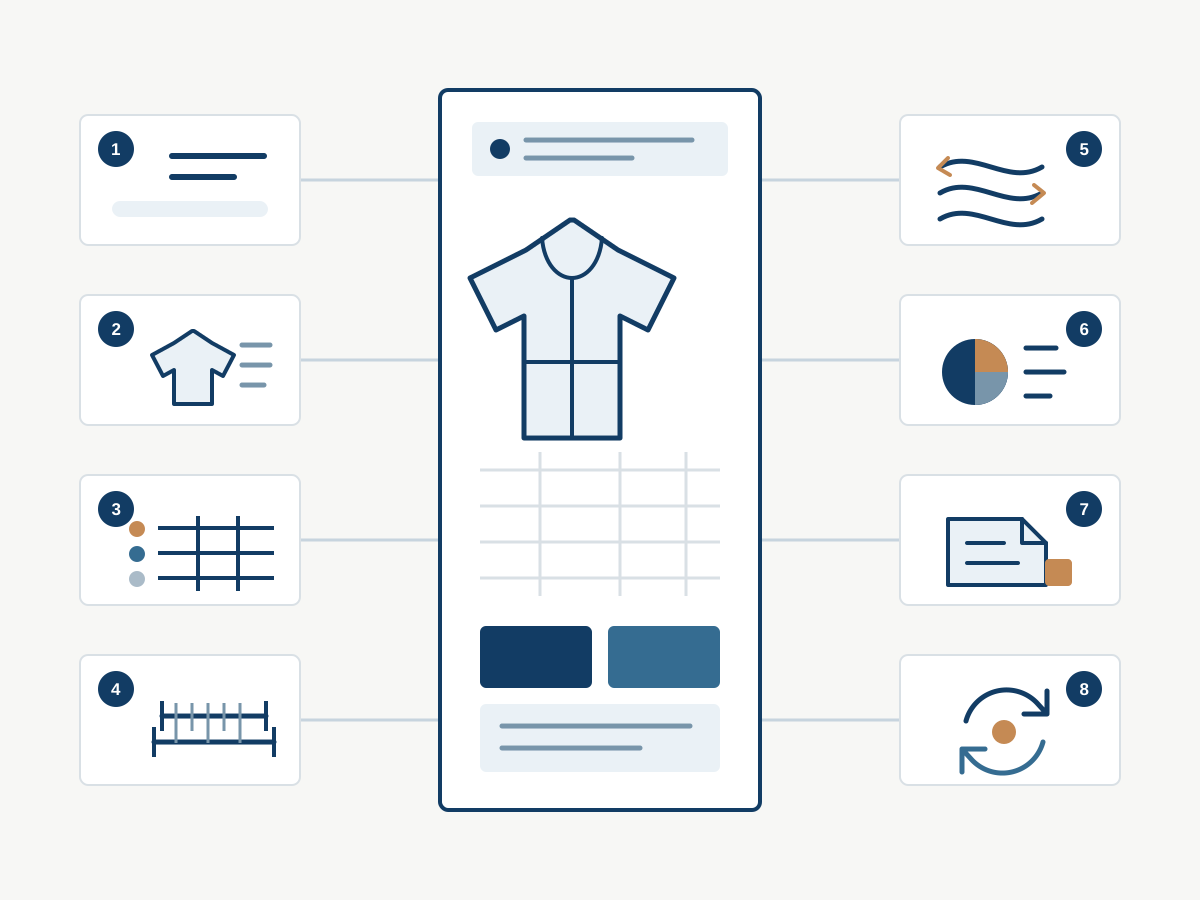
A Tech Pack Develops With the Product
One of the most common misconceptions is that every detail must be final before contacting a manufacturer.
In practice, the document develops as sourcing, sampling and fitting decisions are made. What matters is clearly showing which information is confirmed and which information still needs development.
Quotation-ready
Enough information is available to evaluate the product and prepare an initial price direction:
- Product type and technical flats
- Estimated quantity
- Base measurements or a reference garment
- General material requirements
- Main construction features
- Print, embroidery or wash requirements
- Target market and delivery destination
Sample-ready
The main decisions needed to produce a meaningful development sample have been confirmed:
- Selected or provisionally approved fabric
- Confirmed trims
- Base-size measurement chart
- Construction instructions
- Artwork dimensions and placement
- Label positions
- Fit and silhouette references
Production-ready
The sample, materials and commercial conditions have been approved, and the document reflects the final product:
- Final bill of materials
- Approved measurements and tolerances
- Size grading
- Approved colorways
- Final artwork
- Label and packaging instructions
- Sample comments and approvals
- Current revision number and date
Treating an early document as final can create errors. Leaving every field undefined makes useful costing and sampling equally difficult.
1. Start With Clear Product Identification
The cover or style summary should show:
- Brand name
- Style name and style number
- Product category
- Season or collection
- Intended customer
- Base sample size
- Planned colorways
- Target market
- Document owner
- Version number and revision date
Use a consistent style number throughout all files, emails, sample comments and purchase documents. Names such as "black hoodie final new version" quickly become confusing.
A simple version format such as TP-STYLE014-V03 is much easier to control.
2. Use Technical Flats, Not Only Fashion Illustrations
Technical flats show how a garment is constructed. They should normally include front and back views, with side, interior or enlarged detail views where necessary.
Show visible elements such as:
- Seams and panels
- Pockets
- Pleats and darts
- Openings and closures
- Collars, cuffs and waistbands
- Topstitching
- Rib sections
- Artwork and hardware positions
A mood board or fashion illustration can communicate the aesthetic, but it does not tell a pattern maker where a seam ends or how a pocket is constructed.
Callouts should point to the exact feature being described. Avoid placing a long paragraph beside a drawing and expecting the manufacturer to determine which sentence applies to which detail.
3. Build a Usable Bill of Materials
The bill of materials, or BOM, lists the components required to make and package the product.
Typical entries include the main fabric, lining, rib, interlining, thread, closures, elastics, labels, hangtags and packaging materials.
For each item, provide the available specifications: composition, weight, construction, width, color, finish, supplier reference and placement.
Information that is not yet confirmed should be marked clearly:
ConfirmedSupplier alternative allowedTo be sourcedPending approval
This is safer than leaving a blank cell or presenting an unapproved material as final.
When requesting sourcing support, describe the required performance and appearance. "Soft cotton" is subjective. "Cotton jersey, approximately 180–200 GSM, compact surface, suitable for a regular-fit T-shirt" provides a more useful starting point.
4. Define Measurements and How They Are Taken
A measurement chart should identify the base size, unit of measurement and each Point of Measure, commonly called a POM.
Every POM needs:
- A unique code
- A written description
- A corresponding measurement diagram
- The required measurement
- A tolerance where appropriate
- Size grading when confirmed
The diagram matters because two people may interpret "body width" or "sleeve length" differently.
Also distinguish between body measurements and finished garment measurements. A customer's chest measurement is not normally the same as the finished chest measurement of the garment; the garment may include ease according to its intended fit.
If grading has not been developed, say so. An accurate base-size specification is more useful than an invented full-size chart.
5. Describe Construction Without Creating Conflicts
Construction notes explain how the product should be assembled and finished. Depending on the product, they may cover seam and stitch type, seam allowance, stitch density, reinforcement, edge finishing, hems, pockets, closures and garment finishing.
Use enlarged detail drawings for complicated areas.
If you do not have the technical knowledge to specify a stitch or seam, describe the required appearance and performance and ask the production partner to propose a suitable method. An incorrect technical instruction can be more problematic than a clearly identified open decision.
Any proposal should then be reviewed and added to the revised tech pack before approval.
6. Specify Color and Artwork Precisely
Colors displayed on different screens are not reliable production references.
For textiles, use an appropriate textile color reference and identify the material to which it applies. Physical swatches or lab dips may still be needed because color appearance changes by fibre, fabric construction and finish.
A color specification should identify:
- Color name and reference
- Material to which the color applies
- Whether a lab dip or physical swatch is required
- Approval status
Print and embroidery instructions should include the original artwork file, dimensions, position measurements, color references, technique, scale, orientation and approval status.
"Logo on chest" is not sufficient. Define its width and position from stable garment reference points.
7. Include Labels, Packaging and Destination Market
The destination market should be identified early because labeling and product requirements vary.
The tech pack should identify:
- Main label
- Size label
- Care and composition label
- Country-of-origin information
- Label wording and languages
- Label dimensions and placement
- Hangtag and barcode position
- Folding method
- Individual packaging
- Carton requirements
Final wording and compliance documentation should be confirmed according to the product and destination market.
8. Control Revisions and Sample Comments
A tech pack should remain the single current record of the product.
After each sample review:
- Record the sample version and review date.
- List each issue separately.
- Use photographs or annotated drawings where helpful.
- State the required correction.
- Update affected measurements, BOM entries or construction pages.
- Issue a new document revision.
- Remove or clearly archive obsolete versions.
Avoid distributing corrections across email, messaging applications and separate documents without updating the main tech pack. Otherwise, different teams may work from different instructions.
Common Tech Pack Problems
Before sending the document, check for:
- Missing units of measurement
- Conflicting sketches and written instructions
- Undefined material references
- Measurements without POM diagrams
- Body measurements presented as garment measurements
- Artwork without dimensions
- Colors specified only by screen images
- Missing base size
- No version number or revision date
- Unconfirmed details presented as final
- Missing destination-market information
- Packaging and labels left until after production starts
A visually impressive document can still fail if its technical information conflicts.
A Practical Starter Pack for an Emerging Brand
For an initial manufacturer review, begin with:
- One clearly selected product
- Front and back technical flats
- A base-size measurement chart
- Material direction
- Main construction details
- Estimated quantities by color
- Branding and artwork details
- Target market
- Target price range where available
- Required delivery period
- A list of decisions for which you need sourcing or technical support
You do not need to pretend that every answer is final. A professional tech pack makes uncertainty visible and manageable.
Final Check Before Sending
Ask yourself:
- Can the product be identified without opening another email?
- Can a pattern maker understand the shape and key details?
- Can the sourcing team identify every required material?
- Can the sample room understand the intended construction?
- Are the measurements reproducible?
- Are open decisions clearly marked?
- Is the latest version obvious?
- Is the intended market identified?
- Could the manufacturer explain what is included in the quotation?
If several answers are no, the document probably needs another review.
Send a Better Production Inquiry
All In Denim can review existing tech packs, reference samples and initial product briefs as part of evaluating sourcing, sampling and production requirements in Türkiye.
A clear tech pack does not guarantee immediate feasibility or a final price. It does allow both sides to identify open questions earlier and begin the discussion from a more practical position.
Send Your Tech Pack for Review
References
- Fashion Institute of Technology — Technical Design BS
- Oregon State University — Apparel Design Curriculum
- Johnson County Community College — Apparel Specification Technology
- Pantone — Color Systems for Textiles
- U.S. Federal Trade Commission — Apparel Labeling
- European Union — Textile Labeling Requirements
Related services
Continue from guidance to production planning.
Explore the All In Denim services most closely connected to this guide.
Manufacturing Capabilities
Review sourcing, sampling, production follow-up, quality control and export preparation support.
Production Process
Follow the stages from technical review and sampling through bulk production and export coordination.
Ready-to-Wear & Private Label
Explore product development and production support for private label collections.
Ready to discuss your product?
Send your product brief, tech pack, reference images, estimated quantities, target market, and timeline for an initial production review.