

Production Decisions for Fashion Brands · Guide 1 / 6
Custom Hoodie Manufacturing: Fabric Weight, Fit and Finishing Choices
Plan custom hoodie production with clear fabric, fit and finishing choices. Understand GSM, rib, hood construction, decoration and what to check in a sample.
11 min read
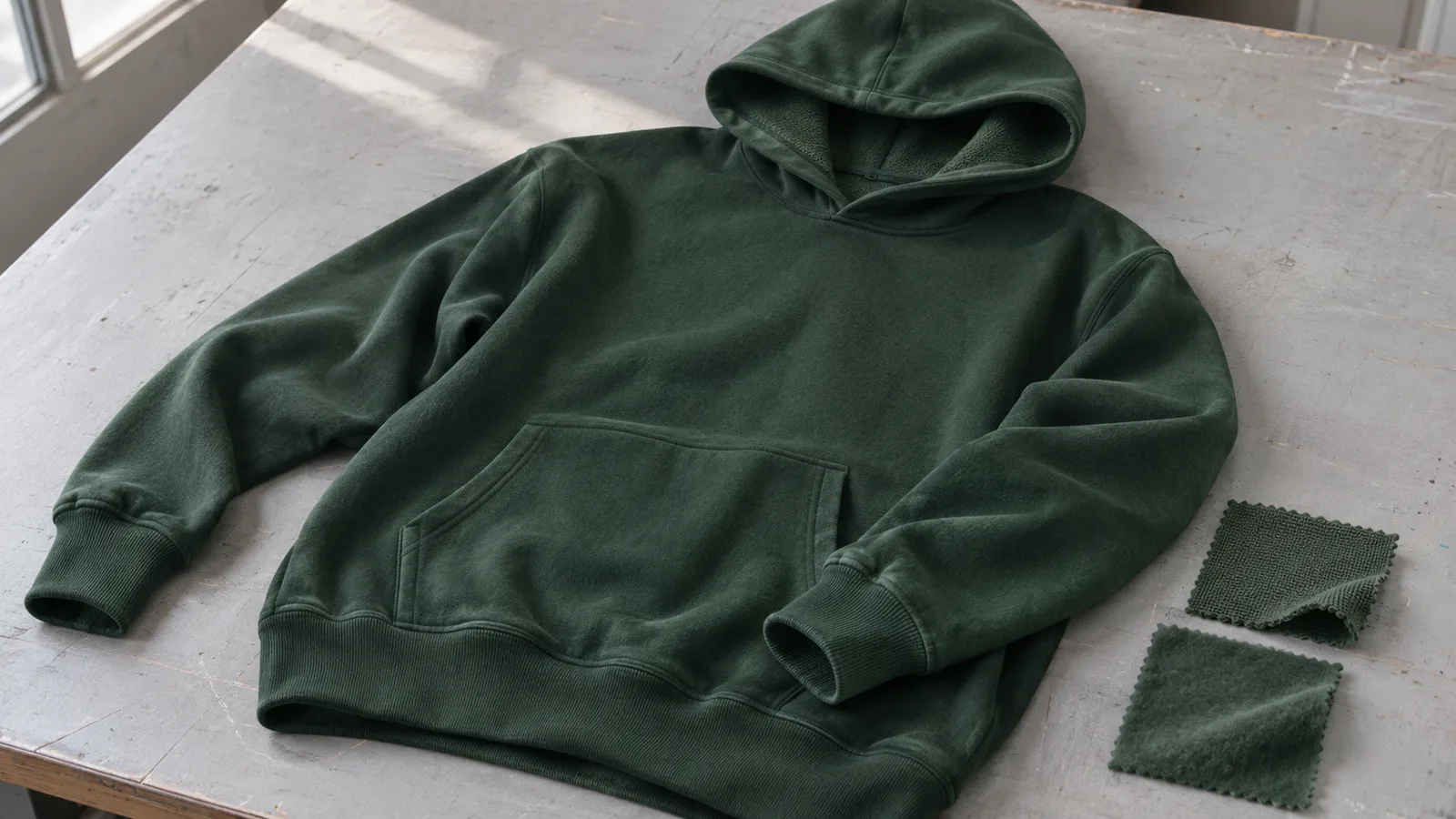
Put two black, 400 GSM hoodies next to each other. One may stand away from the body, with a hood that holds its shape. The other may fall softly at the shoulder and gather at the waist. Both can match the same brief: heavyweight, oversized, cotton.
The difference becomes expensive when you discover it in a sample that has already been cut, sewn and decorated.
For a brand developing a custom hoodie, the useful conversation starts with how the garment should sit, feel and wear. Fabric weight is part of that conversation. So are the knit structure, the proportions of the pattern, the rib and the treatment the finished garment will receive.
Before sampling, the brief needs to connect those choices: which fabric, which proportions and which finish belong to this particular hoodie?
Describe the hoodie while someone is wearing it
A reference photograph usually shows an outfit. It may not show whether the fabric is brushed inside, how much the waistband pulls in or what happens when the wearer raises their arms.
Start with the silhouette you want. Is it a broad, short body with a gathered hem? A longer, relaxed fit that hangs relatively straight? A zip-through intended to sit open over a T-shirt? The same fabric will not necessarily suit all three equally well.
If you send several references, give each one a job: the body proportions from one, the hood shape from another, the surface feel from a physical garment. Identify what you do not want to carry over. Otherwise, the manufacturer has to decide which product you are describing.
A useful brief might read: adult pullover, dropped shoulder, wide body, shorter length, a hem that gathers gently rather than gripping tightly, and a hood with enough structure to sit away from the neck. Those details leave room to develop the product without making the word "oversized" do all the work.
Choose the inside of the fabric as carefully as the outside
French terry, often called loopback, has a visible looped reverse. Brushed sweatshirt fleece has a raised, fuzzy reverse. Either can be used for a substantial hoodie. Neither term tells you the full composition, weight or quality.
The distinction is easy to assess with a swatch. Turn it over, handle both sides and fold it into a double layer. That last check is useful for a lined hood: a fabric that feels comfortable in one layer can become bulky around the face opening or neckline when doubled.
The AS Colour hoodie guide provides a useful commercial example of why weight and construction need to be read together: its range includes different 350 GSM styles, including a cotton French terry model. The number alone does not describe the garment.
Cotton content needs a more specific conversation
"100% cotton" describes fibre content, not whether the hoodie will feel dry, smooth, dense or especially soft. Yarn selection, knitting and finishing still matter. A cotton blend should also be evaluated as a specific fabric rather than accepted or rejected on its percentage alone.
Ask about the fabric face as well as the overall composition, particularly if printing is important. A composition label does not, by itself, explain the yarn arrangement at the surface you intend to decorate.
Compare shortlisted fabrics in similar conditions. If one sample has been washed and another has not, or one has a different softening treatment, their initial hand feel is not a like-for-like comparison. Record the supplier reference and finish alongside the swatch you approve.
Use GSM to narrow the choice, then handle the fabric
GSM means grams per square metre: mass for a given area of fabric. It is not the weight of the completed hoodie, a measure of thickness or a direct quality score.
A loose, bulky fabric and a more compact fabric can have the same GSM and behave differently. The more useful question is whether the fabric gives your intended shape without making the garment awkward to wear or sew.
There is also a straightforward costing implication. For an identical area, 450 GSM fabric contains about 28.6% more mass than 350 GSM fabric. If the price per kilogram were unchanged, that area would cost about 28.6% more. The finished hoodie would not automatically rise by the same percentage: usable width, cutting efficiency, rib, trims, labour and finishing still contribute to the price. In a real comparison, the fabric price per kilogram may also change.
Discuss the weight of the fabric in its agreed finished state, with an agreed tolerance. A nominal weight before a particular finish is not necessarily the weight of the material you receive after it.
Where possible, compare suitable options before committing the whole sample to one. Keep the fit review on an identified fabric. If you switch to a substantially different fabric later, check the fit again rather than assuming the pattern approval transfers unchanged.
Build an oversized fit through proportions
Adding chest width to a regular-fit block is only one change. It does not settle the shoulder line, sleeve volume, armhole shape or body length.
Look at the body and sleeve together. Moving the shoulder seam outward while keeping the same sleeve length can move the cuff farther down the arm. A wider sleeve may also need a different relationship with its cuff. These decisions are visible on a person even when every individual measurement falls within the approved chart.
For the sample review, distinguish chest width, shoulder width, body length, sleeve length and sleeve opening. State where each measurement begins and ends. A sleeve measured from the shoulder seam cannot be compared directly with a neck-to-cuff measurement.
Then try the garment in use. Raise the arms, sit down and put the hands into the pocket. Check whether the hem rides up, the pocket opening feels restricted or the neckline pulls backward when the hood is down. A worn photograph from the front will not answer all of those questions.
Once the base size is right, review how the proportions move through the size range. A larger customer may need more room without the body becoming proportionally much longer. The grading plan should express the fit you intend to sell.
The hood and rib can change the whole garment
The hood is a sizeable part of a hoodie, both visually and in fabric consumption. Its depth, height, neckline attachment and lining affect how it sits up and how it rests behind the neck.
A two-panel hood creates a centre seam. A three-panel hood adds a centre section and another seam line. Either can work; compare their shapes on the intended product. Do not choose a panel count as a shorthand for quality.
Try the hood up and down. Check the face opening, coverage, seam bulk and whether the garment stays balanced at the neckline. If it pulls backward, review the pattern and the relationship between hood weight and body fabric before adding a heavier hood lining.
Rib deserves a separate approval. Cuff and waistband performance depends on the rib construction, recovery and how it is attached to the body fabric. "2x2 rib" is not a complete specification.
The waistband's relaxed width relative to the body affects gathering and the way the hem sits. Its depth affects the proportions. At the cuff, check whether the opening is comfortable to pull over the hand and whether it returns after wear. A quick stretch by hand is useful for comparison, but it does not replace an agreed performance test.
Review body fabric and rib together after the intended wash. Matching them only by colour before sewing leaves their combined behaviour untested.
Plan the decoration while developing the garment
A small chest embroidery and a large back print ask different things of the fabric. Send the actual artwork, dimensions and placement while the garment is being developed, even if final colours are still being discussed.
For embroidery, inspect the reverse as well as the face. A clean logo can still feel stiff against the chest or distort the fabric around it. Madeira's technical guidance identifies backing selection, stitch density, tension and framing as factors in stiffness and puckering. Adding more stitches is not a reliable way to improve the result.
Printing should be sampled on the intended fabric and colour. A smooth result on a cotton test panel does not establish the result on a dyed cotton/polyester hoodie. Avient's Wilflex dye migration guidance explains how dyes can move into the ink layer, particularly affecting light prints on susceptible polyester-containing materials. The printer needs to assess the substrate and process together.
Also check the design on the worn garment. A hood resting down can cover the top of a back print. A large graphic placed across a kangaroo pocket needs to account for the pocket edges and the printing sequence. If a garment wash is planned, agree whether decoration happens before or after it and approve the result in that sequence.
An early fit sample can be plain. Printing or embroidery trials on the selected fabric can resolve the surface effect before you pay to decorate a complete garment. Before bulk, review the approved decoration on the finished hoodie as well, so placement, fit and the intended treatment have been checked together. Keep the artwork file, placement measurement and physical result associated with the same sample revision.
Wash the sample before treating the fit as settled
Suppose a hoodie body measures 70 cm before washing and loses 4% of its length under the chosen wash-and-dry conditions. It would measure 67.2 cm afterward. That is a 2.8 cm change in a garment whose length may have been carefully chosen to sit at the waistband.
This is an illustration, not a shrinkage allowance for hoodies. The acceptable result and the test conditions need to be agreed for the actual product.
Avoid correcting the pattern from one percentage alone. Confirm that the material and processing are stable, then review length and width changes separately. Body, rib, hood lining and sewing thread may not respond in the same way. Changes between connected components can alter the appearance of the assembled garment.
Define the washing and drying procedure, the number of cycles, the measurement points and the conditions for remeasurement. "We washed it" leaves too much unspecified. AATCC publishes separate methods for dimensional changes in fabrics and finished garments. The appropriate method and conditions should be selected with the testing provider; the public summaries are not full test instructions.
Alongside measurements, inspect the finished appearance: side seams turning, rib drawing in, surface change, embroidery distortion and print condition. A fabric report helps with material approval. It does not show how every component in your completed hoodie behaves together.
Make the construction visible in the approval
Turn the sample inside out. Follow the hood attachment, pocket corners, underarm joins and rib seams. Check the approved stitching, loose ends, bulky intersections and any visible damage around needle penetrations. Stretch relevant areas gently in normal use; a neat-looking seam may still be unsuitable for the movement it needs to allow.
For a zip-through, close the zipper and look at the centre front both laid flat and worn. Check alignment and waviness before and after washing. A wavy front needs diagnosis rather than an automatic change to a more expensive zipper. Fabric feeding, sewing tension and differences in dimensional behaviour are among the factors described in Coats' seam-puckering bulletin.
Record the zipper reference, length and finish, along with puller, drawcord, eyelets and label details where used. Changes to those items can affect appearance and sewing operations. Confirm them in the bill of materials rather than leaving the sample room to choose the nearest available alternative for bulk.
Ask for a quotation against an identifiable product
If you are comparing quotations, send the same product information to each manufacturer. Otherwise, a lower price may simply describe a different fabric, hood construction, decoration process or packing requirement.
For a useful first review, send:
- A sketch or reference garment, with notes on the features you want to retain or change
- Pullover or zip-through construction, intended wearer and size range
- Fabric direction: loopback or brushed, composition preference, weight direction and physical reference if available
- Fit and key measurements, including how each measurement is taken
- Hood, rib, pocket and trim details
- Artwork, decoration dimensions, placement and intended garment finish
- Quantities by colour and size, destination market and required delivery window
List what is confirmed and what you want the manufacturer to propose. You do not have to settle every fabric detail before making contact. You do need to distinguish an open development choice from a requirement the quotation must meet.
For the underlying documents, use our guides to building a tech pack and planning costs, minimums and timelines.
Develop your hoodie with All In Denim
All In Denim manufactures apparel in Türkiye and develops samples in-house. For a custom hoodie project, share the reference, fabric direction, fit, artwork and quantity breakdown so we can review the product and the work needed before bulk production.
Our knitwear and jersey manufacturing page covers the wider category. To discuss a specific hoodie, send your project details, including any decisions you would like to resolve during sampling.
Technical references
- AS Colour: Our Guide to Choosing the Right Hoodie
- Madeira: Embroidery, Backings and Technical FAQs
- Avient / Wilflex: Dye Migration Solution Guide
- AATCC TM135: Dimensional Changes of Fabrics after Home Laundering
- AATCC TM150: Dimensional Changes of Garments after Home Laundering
- Coats: Eliminating Seam Puckering
Related services
Related Manufacturing Services
Explore the All In Denim services most closely connected to this guide.
Knitwear Manufacturing
Explore T-shirt, hoodie and jersey manufacturing, from fabric weight and rib details to sample approval.
Ready-to-Wear & Private Label
Explore clothing development and manufacturing with your brand labels, care information and retail packaging.
Production Process
Follow the stages from technical review and sampling through bulk production and export coordination.
Ready to discuss your product?
Send your product brief, tech pack, reference images, estimated quantities, target market, and timeline for an initial production review.