

Production Decisions for Fashion Brands · Guide 2 / 6
Developing a Denim Collection: Fabric, Washes and Fit
Develop a denim collection with connected fabric, wash and fit approvals. A practical guide to stretch, shade, finished measurements, trims and bulk consistency.
11 min read
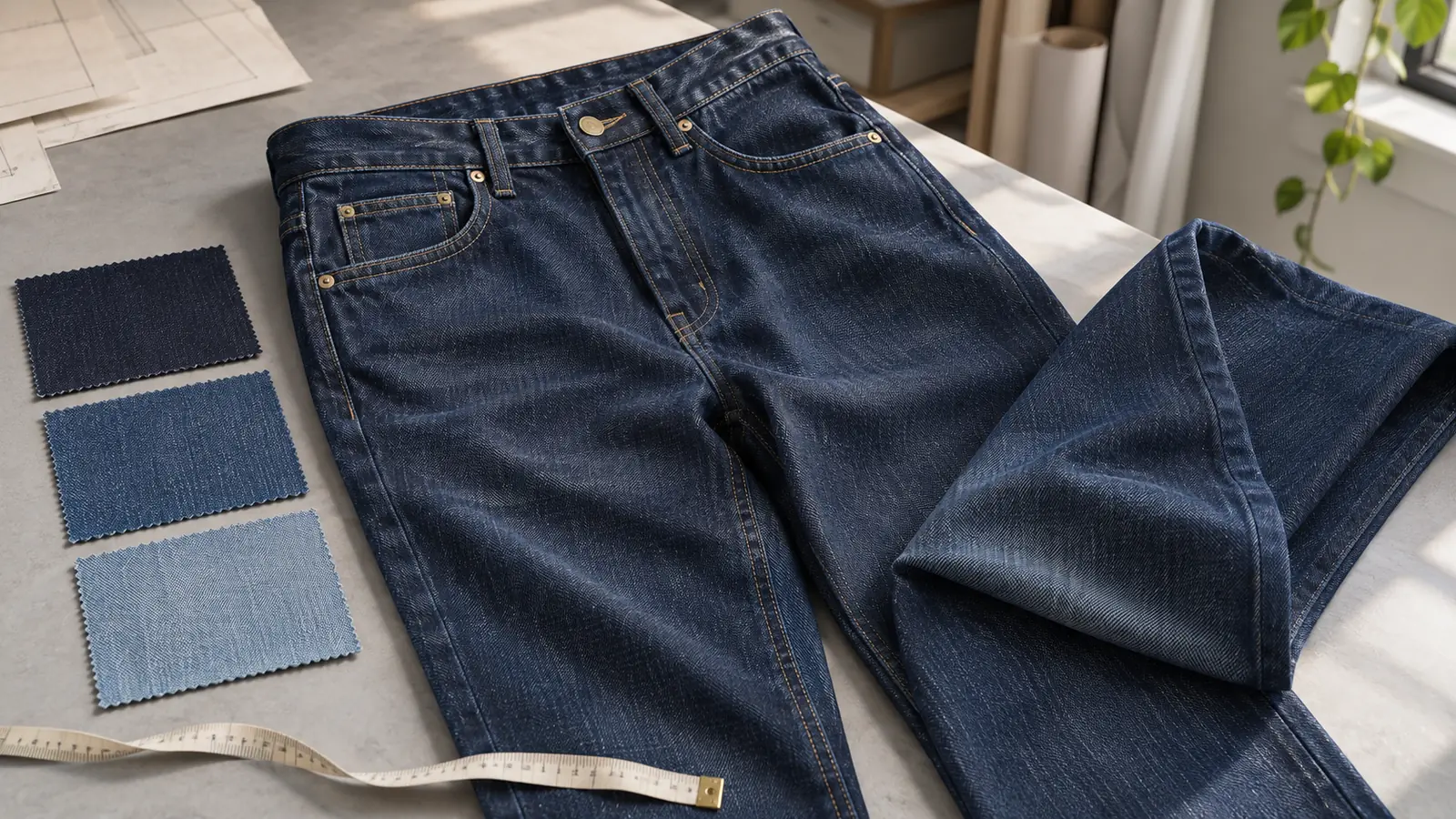
Approving a dark, lightly rinsed sample and then asking for a pale vintage finish leaves an important question open: how will that same garment fit after the new treatment?
The pattern may be unchanged. The fabric reference may be unchanged. Yet the finished measurements, surface and feel still need another review. A successful colour trial does not settle the whole product.
This is where denim development needs a little discipline. A collection brief should connect a fabric reference, a fit and a finish, so everyone knows which combination has actually been approved. That applies to a first run of jeans as much as to an established brand adding a new wash.
Give each fabric a job in the collection
A collection can share a visual language without every garment using the same denim. A structured jacket, a close-fitting skirt and a relaxed straight-leg jean ask different things of a fabric.
Begin with the intended wearer and silhouette. How should the leg hang? Should the waist feel firm, or give as the wearer sits? Is the jacket meant to hold a boxy shape or move more softly? These questions give a fabric developer more direction than "premium denim" or "good stretch".
If you want to share one fabric across several styles, trial it on the relevant shapes. Sharing a mill reference can simplify purchasing, but it does not remove the need to approve each finished product.
Keep track of the combinations. Three fits, two fabrics and two washes create twelve possible development combinations, even before additional colours or trims enter the brief. That is a planning example, not a requirement to sample all twelve. It helps identify where you need a meaningful comparison and where a decision can be made earlier.
For a smaller first collection, settling a fabric-and-wash direction on one lead style can give the next samples a useful starting point. Keep the final fit approvals specific to each style.
Select the fabric you can develop, not just the swatch you like
A denim swatch communicates colour, weave character and hand feel. It may not have been through the finish you intend to sell.
Ask what state the swatch represents. Is it the mill-finished fabric, a washed cutting or material taken from a finished garment? Record its article code, composition, weight, usable width and finishing history where available. If you approve a washed cutting, keep the underlying fabric reference with it.
Denim weight is often expressed in ounces per square yard. Make sure the unit and material state are stated rather than comparing numbers alone. The weight of a finished pair also depends on size, pattern, trims and processing.
Handle the cloth in a garment-sized piece where possible. A small square can feel pleasingly dense while telling you little about how a wide leg will fall. Conversely, a softer cloth may suit a draped style but fail to produce the upright shape shown in your reference.
Look at the fabric face and reverse together. Yarn irregularity, weave and dye character can contribute to a finished look, but they do not establish that a particular wash will work. Ask for a trial using the actual shortlisted quality rather than approving the fabric and wash in separate conversations.
Rigid and stretch denim need different fit decisions
Rigid denim gives the pattern less help when the wearer moves. Ease through the seat, thigh and rise needs to be deliberately developed. A stretch quality can allow a closer fit, but its ability to extend is only part of its behaviour.
Ask how the fabric returns after extension. Stretch describes how much it extends under defined conditions. Growth concerns extension left after a specified recovery period. Recovery describes its return. A fabric that feels accommodating in a quick fitting may still need a more careful assessment of shape retention.
The elastane percentage cannot answer all of that. Yarn construction, fabric construction and processing need to be considered with the composition. Nor should terms such as "comfort stretch" or "high stretch" be treated as fixed specifications shared by every supplier.
For a proposed stretch fabric, request its relevant performance data and ask which condition was tested. Was it tested as supplied by the mill or after the intended garment finish? Results from different procedures or recovery periods should not be treated as directly interchangeable. Agree the suitable method and acceptance criteria with the testing provider and manufacturer.
During fitting, sit, bend and walk in the sample. Examine the waist, seat and knee afterwards. A wear trial helps reveal the questions to investigate; it does not replace a defined fabric test.
If you change from rigid to stretch denim, or between substantially different stretch qualities, review the pattern again. Keeping the same measurement chart does not guarantee the same fit experience.
Turn the wash reference into something people can approve
"Medium blue vintage" leaves a considerable amount unresolved. Two garments may have a similar overall shade and still differ in cast, contrast, pocket appearance and the position of worn effects.
Separate the reference into observable features. Identify the base shade and undertone, the contrast between dark and light areas, the location and intensity of fading, and any tint, abrasion or deliberate damage. Check the reverse, pocketing and seams as well as the front face.
A physical garment is useful because screens, lighting and camera settings change how blue appears. If you only have photographs, identify which image governs colour and which governs placement or texture. Use the resulting development sample to establish a physical reference before bulk.
There may be more than one route to an appearance. Jeanologia's garment-finishing overview distinguishes laser marking, ozone treatment and other finishing technologies. For a buyer, the important question is which feasible process produces the agreed result on the selected fabric. A process name alone does not define the shade, hand feel or finished measurements.
If a lower-impact finish is part of the collection brief, ask what is measured for the proposed process and against which baseline. Keep the supporting data with the approval. An equipment name alone should not become a percentage-saving claim on the product page.
Ask the finishing team to keep the trial linked to its fabric and sample revision. When a result is revised, identify what changed. A lighter wash approved in a message should not silently replace the physical reference used for the rest of the order.
Fit approval belongs to an identified finish
An early sample can be used to resolve the basic shape before the final wash is developed. Treat that as a specific development stage. The final approval should bring the selected fabric, pattern and intended finish together on the same garment.
Distinguish measurements before processing from those of the finished product. A useful record states when the garment was measured and how it was prepared for measurement. Otherwise, the sample room, laundry and buyer may be comparing different conditions while using the same style code.
Check the waist, hip, front and back rise, thigh, knee, leg opening and inseam as appropriate to the design. Review their relationship on the wearer, too. A waistband may meet its flat measurement while the distribution of room through the seat still needs work.
Fabric stabilisation is relevant, but it does not replace product testing. Candiani's explanation of denim finishing describes sanforization as a shrinkage-control treatment and skewing as a treatment addressing twist. Neither a finishing label nor a mill description should be used as a promise that every finished garment will remain unchanged through subsequent processing and care.
Look at the legs after finishing and after the agreed care trial. If a side seam turns noticeably, keep the sample and investigate the fabric, cutting and construction with the technical team. Do not automatically correct one seam on the pattern before establishing the cause.
The factory finish and the customer's later washing are different stages. A sample that meets measurements after an industrial wash still needs the agreed checks for its intended care. AATCC's garment dimensional-change method summary illustrates why washing and drying conditions must be specified. Choose the appropriate test with the laboratory; the public summary is not a full test procedure.
Place the worn effects on the body, then review the sizes
Whiskers, knee fades and abrasion are placement decisions as well as colour decisions. A convincing finish on a flat pair can look misplaced once the jeans are worn.
Check where the effects sit relative to the crotch, pockets and knee. A low-rise and a high-rise style should not automatically receive the same placement file. Neither should two very different leg shapes simply inherit an effect because they share a fabric.
The size range needs attention here. Review whether a placement should remain fixed from a defined construction point or change with the size. Scaling every detail by the same percentage can put visual wear in the wrong location. Keep measurements or an annotated placement reference with the approved appearance.
Deliberate distressing also changes what you are inspecting. Agree the location and extent of openings, fraying and abrasion, and review the treated areas after the relevant checks. The intended appearance should be distinguishable from unplanned damage.
Let the trims go through the development process
The waistband patch, pocketing, thread and metal components are part of the finished denim product. They need to be compatible with the route used to make it.
Clarify which items are attached before finishing and which are applied afterwards. A sample assembled with a temporary patch or different sewing thread may not represent the result of the final component combination. Thread colour, patch appearance and metal finish should be reviewed in the state in which the buyer receives the garment.
On a trial garment, inspect pocket openings, belt-loop attachments, fly alignment, buttonholes and thick seam intersections. For close-fitting styles, check the movement required at the seat and other relevant seams. An attractive topstitch does not establish the performance of the assembly beneath it.
Record the approved references and sequence in the bill of materials and production notes. If a trim changes, review whether another finishing trial is necessary. Avoid treating a late substitution as equivalent purely because it looks similar before washing.
Check colour transfer separately from fading
The way denim loses colour during an intended wash and the way it transfers colour by rubbing are different questions.
A dry-handling check does not establish wet-rubbing performance. Nor does a successful wash-colour result answer every question about contact with a light-coloured top, pocket lining or other surface.
AATCC's crocking method summary covers colour transfer by rubbing and distinguishes dry and wet conditions. It also notes that treatment can affect the result. Specify the required test condition and evaluate a sample representative of the finish you will supply.
Do not set an arbitrary universal grade in the brief because it appeared in someone else's specification. The requirements should reflect the product, market and buyer programme, agreed with a competent testing provider. Any relevant checks for strength, seam performance, dimensional behaviour and finished appearance should also be planned; one colourfastness result is not a complete denim quality approval.
Make the approved result usable in bulk
A finish sample is most useful when someone can identify what produced it. Retain the approved garment together with the fabric reference, style and pattern revision, finish reference, trim details and approval record.
Discuss material lots and shade control before the order is cut. When a fabric or lot is substituted, assess whether the approval still represents the proposed production material. Do not expect a finishing team to reproduce a reference consistently while the input cloth changes without review.
Ask how the development process will be transferred to bulk equipment and batch conditions, and who will review the first production output. A recipe or digital file is part of that handover, but the production result still needs to be checked against the physical reference.
Agree how any acceptable shade variation will be assessed. If a range is needed, use identified physical limit samples or another agreed assessment method rather than "a little lighter is fine". Clarify who can accept a deviation and what happens when a batch falls outside the agreed result.
If the style is intended for repeats, keep a protected master reference and its records. An unrecorded change to the fabric, finish or trims can turn a repeat order into a new development exercise.
Our guide to moving from an approved sample into bulk production covers the wider production handover and shipment checkpoints.
What to send for a denim development review
Send enough information to show the manufacturer what is fixed and what still needs to be developed:
- The collection styles, intended wearer, fit direction and size range
- A tech pack, reference garment or annotated sketches with key measurements
- Fabric references or preferences, including known composition, weight and stretch requirements
- A physical wash reference where available, with notes separating shade from placement and surface effects
- Patch, thread, metal-trim, pocketing and label requirements
- Quantities by style, wash and size, destination market and required delivery window
- The current sample stage and any buyer-specific testing or approval requirements
If fabric or wash development is still open, say so. The manufacturer can then distinguish an initial development estimate from a quotation against an approved specification. For the wider material brief, see choosing fabrics, trims and colours.
Develop your denim collection with All In Denim
All In Denim develops and manufactures jeans and denim garments in Türkiye for international fashion brands. We produce samples in-house and review wash and shade development with specialist finishing suppliers before bulk production.
Explore our denim and jeans manufacturing capabilities, or send your collection details with the styles, fabric direction, wash references and quantity breakdown. Include any questions you want to resolve through sampling.
Technical references
Related services
Related Manufacturing Services
Explore the All In Denim services most closely connected to this guide.
Denim & Jeans Manufacturing
Explore jeans and denim manufacturing, from in-house fit samples to washes, branded trims and bulk production.
Production Process
Follow the stages from technical review and sampling through bulk production and export coordination.
Quality Control & Compliance
See how approvals, measurements, inspections, packaging and documentation are coordinated.
Ready to discuss your product?
Send your product brief, tech pack, reference images, estimated quantities, target market, and timeline for an initial production review.